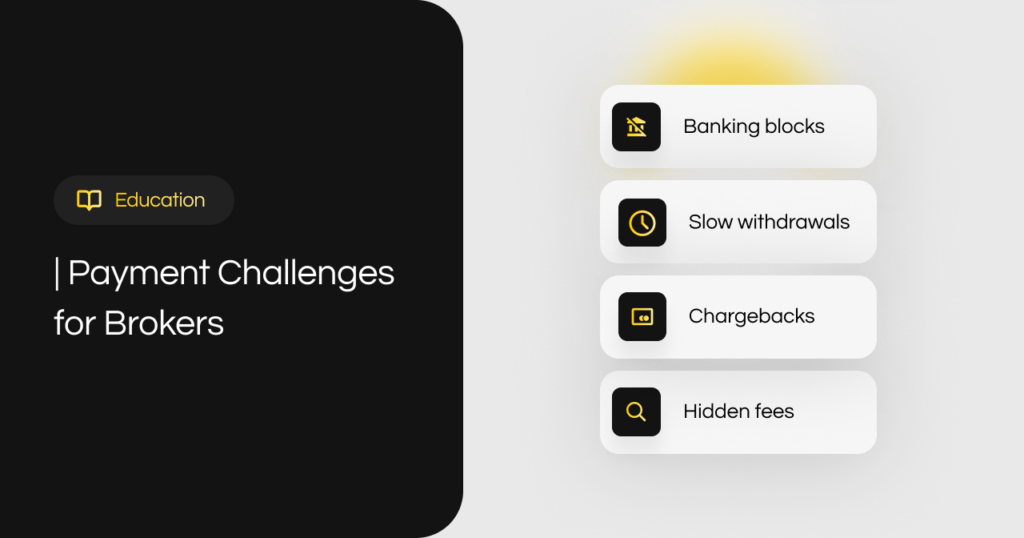
- CFD brokers sit in the high-risk merchant category by default, which limits banking options before a single trade is placed.
- Blocked deposits and slow withdrawals cost brokers conversions, retention, and public reputation.
- Hidden fees, rolling reserves, and chargeback exposure erode margins more than most operators realize.
- Crypto payment infrastructure shortens settlement windows and removes most of the friction tied to traditional rails.
- A specialized CFD payment gateway provides brokers with stable processing without forcing changes to the client experience.
CFD broker payment processing has become one of the hardest operational problems in the industry. Acquiring banks tighten thresholds every quarter, processors quietly drop entire segments, and traders abandon onboarding the moment a deposit fails. Operators in Cyprus, Dubai, and Southeast Asia describe the same pattern: legitimate volumes growing, but the capacity to move money in and out shrinking. This article breaks down the four challenges that hit CFD brokers hardest, and how crypto rails address each one.
Why Do Banks Treat CFD Brokers as High-Risk?
Most acquirers classify CFD brokerage alongside binary options and unregulated forex. The classification rarely reflects the compliance posture of a regulated operator, and it triggers higher MCC fees, rolling reserves of 5 to 10 percent, and tighter monthly volume caps. A clean license and audited financials do not exempt a CFD broker from the high-risk label once a card scheme has tagged the merchant category.
This treatment cascades. Once one acquirer offboards a broker, future applications inherit the prior file, and reapplying becomes harder each cycle. Brokers end up cycling through second-tier processors with worse pricing and unstable uptime.
The Real Cost of Blocked Deposits
When a deposit fails, the trader rarely retries. Internal data from several operators indicate that the conversion drop after a single payment failure is 35 to 50 percent for first deposits. The lost client also tends to leave a public review describing the issue, which compounds the acquisition cost of the next campaign. Blocked payments are the most expensive form of churn in the CFD industry because they target traders who have already chosen your platform over a competitor.
Withdrawal blocks hurt more. A trader who cannot withdraw winnings within a reasonable timeframe often disputes the deposit with their card issuer, which drives up the chargeback ratio and threatens the relationship with the processor. Payout speed is now a retention metric.
Where Fees Pile Up in Practice
Most CFD operators benchmark only the headline rate quoted by their processor. The real cost lies in less-visible items: cross-border interchange uplifts, FX margins on settlement currency conversions, monthly minimums, rolling reserves locked for 180 days, and the cost of disputing chargebacks individually. Effective payment costs of 6 to 8 percent are common even when the contract states 3.5 percent.
A second cost layer comes from operational overhead. Manual payouts, reconciliation across multiple PSPs, and customer support hours spent on stuck transactions all consume headcount that should be allocated to sales or trading operations. A separate breakdown of payment processing costs in iGaming and forex covers how operators benchmark these line items against crypto rails.
How Crypto Payment Rails Solve the Bottleneck
A CFD payment gateway built for crypto removes the structural problem at the source. There is no card scheme assigning a high-risk MCC. The acquiring bank dependency disappears entirely. And once a transaction confirms on-chain, no chargeback mechanism lets a trader claw it back. Settlement of USD-based stablecoins arrives within minutes of on-chain confirmation, while compliance checks run in real time upon confirmation rather than the multi-day cycle typical of SWIFT.
Match2Pay’s crypto payment gateway for CFD brokers covers three deployment models: processor, non-custodial, and white-label, with two enabling regulated brokers to launch in roughly 48 hours. The platform charges 0% on stablecoin settlement. It applies a standard spread only to fiat-to-fiat conversions, giving finance teams predictable costs without holding crypto on the balance sheet. Custody and compliance are regulated under a Seychelles FSA license, and the API connects directly to the CRM and cashier systems most CFD brokers already use.
Ready to Remove Payment Friction from Your Brokerage
If banking refusals, frozen reserves, or slow withdrawals are limiting your growth, Match2Pay can deploy a crypto payment layer alongside your existing fiat stack. Contact the Match2Pay team to scope a processor, non-custodial, or white-label setup tailored to your license, jurisdiction, and CRM. Most regulated brokers go live within 48 hours.
Frequently Asked Questions
What makes CFD broker payment processing different from standard e-commerce?
CFD brokers fall under high-risk merchant categories due to leverage, frequent disputes, and regulatory variability across jurisdictions. This translates into stricter acquirer requirements, higher fees, and rolling reserves. Standard e-commerce processors are usually unwilling to underwrite the segment beyond a small initial volume.
Can crypto payments replace fiat rails entirely for a CFD broker?
For most brokers, the right model is a hybrid one, with crypto handling deposits and withdrawals in markets where card acceptance is weak or banking is restrictive. Fiat remains relevant in regulated EU markets where cards still convert well. The objective is to reduce dependency on any single rail.
How fast can a CFD broker integrate a crypto payment gateway?
With a provider like Match2Pay, two of the three deployment models enable regulated brokers to launch within 48 hours via direct CRM and cashier connectors. Full white-label setups take longer due to the need for branding and compliance customization. The API itself requires limited developer involvement on the broker side.