- A Forex CRM crypto integration handles deposits, withdrawals, and conversions through a single API connection.
- Match2Pay’s processor and non-custodial models enable regulated brokers to go live in roughly 48 hours.
- Webhooks deliver real-time confirmations to the CRM, removing the manual reconciliation step.
- Automated payouts run with double-confirmation conditions on the API layer, an option few competitors offer.
- Most integrations require limited developer time on the broker side, often a single sprint.
Brokers asking how to integrate crypto payments into a Forex CRM usually expect a quarter-long project. In practice, the work is far smaller. The Forex CRM holds the client record, the cashier, and the trading account, while a crypto gateway sits next to it as a payment method, listening for deposits and pushing payouts on instruction. This guide walks through the architecture, the steps, and the security model behind a typical Match2Pay deployment.
What a Forex CRM Crypto Integration Must Handle
Before any technical work begins, the integration brief should answer five questions: which chains and tokens to accept, which CRM events trigger a payout, how stablecoin balances settle to fiat, who holds the keys, and how compliance signals flow back to the operator. Most failed integrations skip the keys and compliance question early, then rebuild the architecture later when audit requirements surface.
A clear brief makes the rest of the project mechanical. With Match2Pay, brokers pick a deployment model, processor, non-custodial, or white-label, and the answers to all five questions fall out from that choice.
The Integration Architecture in Plain Terms
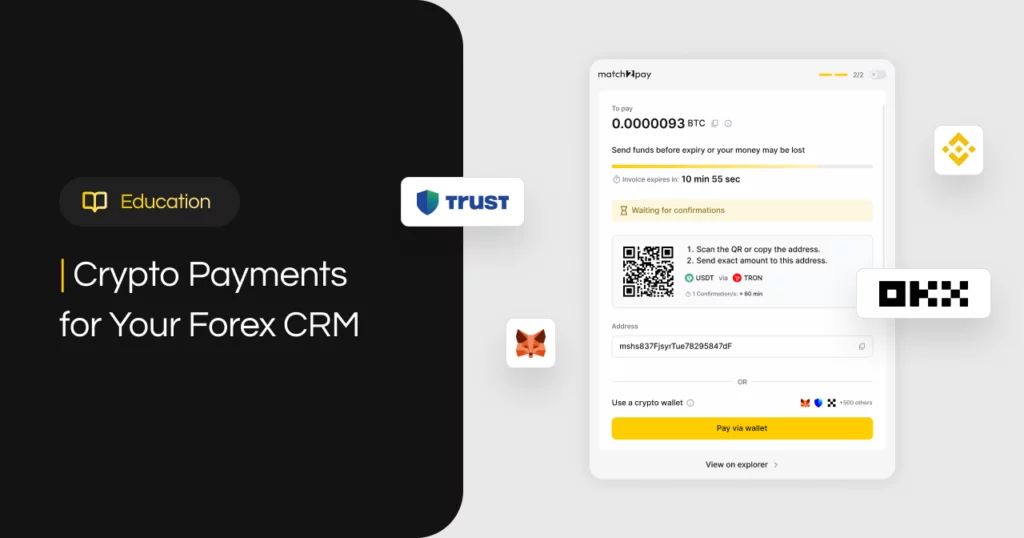
The crypto gateway exposes a REST API and a set of webhooks. The CRM calls the API to create a deposit address or push a payout, and the gateway calls the CRM’s webhook endpoint when funds are confirmed on-chain. Match2Pay supports transactions across chains such as TRC-20, ERC-20, and Solana, as well as off-chain methods like Binance Pay.
On the settlement side, USD-based stablecoins clear at 0 percent on the stablecoin leg, while fiat-to-fiat conversions carry a standard market spread. The broker sees fiat in the cashier even when the trader paid in stablecoin, which keeps the user experience consistent with the existing card and bank flows.
The Integration Steps from Kickoff to Live
A typical project runs in five steps. First, the broker confirms jurisdiction and license so the gateway can map the right compliance flow under the Seychelles FSA umbrella. Second, the team scopes the CRM’s existing payment module, since most popular Forex CRMs expose a cashier API that maps directly to the gateway. Third, the dev team installs and configures the API credentials and webhook endpoints.
Fourth, both sides run sandbox transactions across each supported chain, covering successful deposits, expired addresses, refunds, and the wrong-network recovery scenario. The fifth step, going live, takes hours rather than days once the sandbox passes, which is why two of three Match2Pay deployment models reach production in roughly 48 hours. Brokers can preview the milestone-by-milestone cadence in this practical 48-hour onboarding guide.
Security and Double-Confirmation for Automated Payouts
The payout path is where most brokers want extra control. Match2Pay applies double-confirmation conditions to automated CRM-driven payouts, meaning a payout instruction from the CRM is validated against a second control before any on-chain transaction is signed. Recent withdrawal-verification upgrades extend this layer by adding additional checks at the gateway level. This blocks the most common abuse vectors, including compromised CRM sessions and bonus exploitation, without forcing the operations team to revert to manual approvals.
Compliance signals run on confirmation in real time. The broker sees AML and sanction screening outcomes the moment a deposit clears, rather than the multi-day cycle typical of SWIFT or correspondent banking.
What Changes for the Brokerage Once Integration Is Live
The first visible change is reconciliation. Manual matching of deposits against trader accounts is no longer necessary because every confirmed transaction posts back to the CRM with the trader’s reference attached. Finance teams move from chasing missing deposits to monitoring exception reports.
The second change is global reach. Brokers serving traders in regions where card acceptance is weak see deposit success rates climb sharply after integration, since the friction of cross-border interchange and currency conversion no longer sits on the trader’s side. Crypto becomes a quiet, dependable layer alongside existing fiat methods rather than a competing product.
Plan Your Forex CRM Crypto Integration
Match2Pay supports direct integrations with the Forex CRMs that most regulated brokers already use. Reach out to the Match2Pay team to scope the project, map your existing cashier, and confirm a realistic timeline based on your jurisdiction and license. Two of the three deployment models put a regulated broker live in roughly 48 hours.
Frequently Asked Questions
How long does a typical Forex CRM crypto integration take?
For regulated brokers using the processor or non-custodial model, integration typically takes about 48 hours from kickoff to live, assuming the CRM exposes a standard cashier API. White-label deployments take longer due to branding and compliance customization. Most of the broker-side work fits in a single development sprint.
Which chains and tokens does Match2Pay support for Forex brokers?
Match2Pay supports stablecoin transactions across major chains, including TRC-20, ERC-20, and Solana, with USD-based stablecoins for settlement. Binance Pay is available as an off-chain instant payment method alongside the on-chain options.
Does the broker need to hold crypto on the balance sheet after integration?
No. Match2Pay settles the stablecoin leg at 0 percent and routes the fiat conversion through the chosen model, with the standard market spread applied only to fiat-to-fiat conversions. The broker sees fiat in the cashier and on financial statements, while crypto handling stays at the gateway layer.