- Banks classify CFD brokers as high risk by default, so accounts, transfers, and settlements are on borrowed time.
- Small brokers feel the squeeze first because they lack the volume and negotiating power that buy larger firms’ tolerance.
- Rolling reserves, inflated effective fees, and surprise offboarding are structural features of high-risk payment processing, not bad luck.
- Crypto settlement gives small CFD brokers an alternative to SWIFT that no bank committee can switch off.
A small CFD brokerage can survive thin spreads, aggressive competitors, and slow months. What it cannot survive is losing the ability to move money, and that is exactly where traditional banks keep tightening the screws. Banking issues cost CFD brokers more clients than any market drawdown, and the smaller the broker, the harder the squeeze.
The High-Risk Label Arrives Before the First Trade
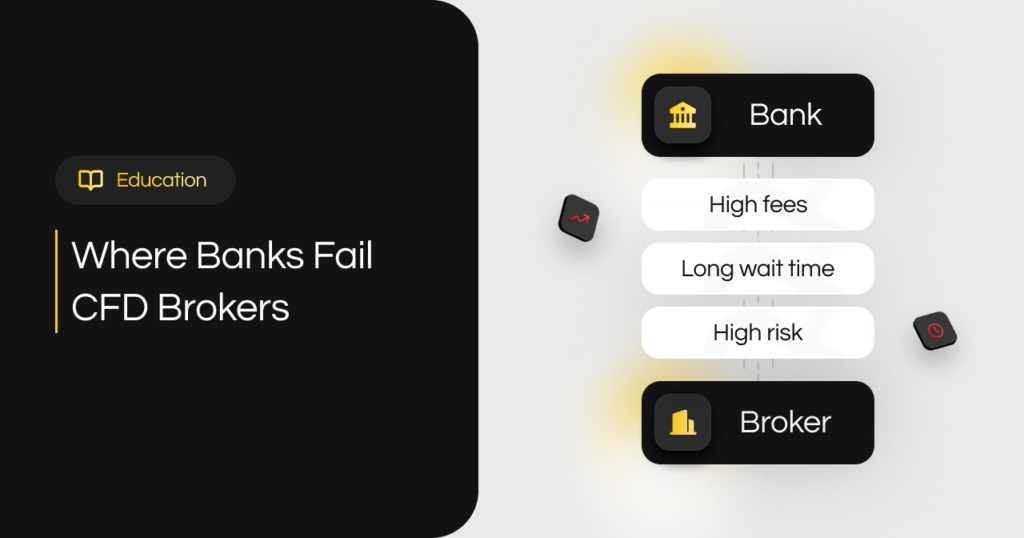
Most acquiring banks file CFD brokerage next to binary options and unregulated forex, regardless of the license behind the business. The classification triggers the full high-risk toolkit: rolling reserves of 5 to 10 percent, locked for up to 180 days, monthly volume caps, and worst-case pricing. A clean regulatory record does not remove the label once the merchant category is set.
The label also follows you. When one acquirer offboards a broker, the next application inherits the file, and each cycle through second-tier processors ends with worse pricing and shakier uptime. For a small operation, three or four of those cycles can consume an entire year of growth.
Small Brokers Pay What Big Brokers Negotiate Away
Large brokers absorb banking friction with multiple entities, redundant processor relationships, and legal teams that push back on every reserve demand. A small CFD broker has none of that cushion, so the published rate is only the beginning. Cross-border interchange, FX margins on settlement, monthly minimums, and dispute fees routinely push effective costs to 6 to 8 percent on contracts that promised 3.5 percent.
The revenue side takes the bigger hit. A single failed first deposit cuts the chance of converting that trader by 35 to 50 percent, and the decline usually has nothing to do with the broker at all. A card scheme rule, a correspondent bank filter, or a country flag makes the decision, and the client blames you.
Bureaucracy Is the System Working as Designed
Every intermediary in a SWIFT chain can hold, question, or reject a transfer, and each one earns fees and floats while your settlement waits. Compliance reviews drag on for weeks precisely because nothing in the process is built around a business that operates in real time.
The timetable mismatch says it best. Markets trade around the clock, traders expect payouts on Saturday night, and the banking system still closes for the weekend. A small broker promising modern service on top of that infrastructure is writing checks its payment rails cannot cash.
The Alternative to SWIFT Already Works
Crypto settlement removes chokepoints rather than renegotiating them. Deposits clear on-chain in minutes, no card scheme assigns a merchant category, and a confirmed transaction cannot be charged back. Conversion to stablecoins at a fixed 1:1 rate means the broker books the exact fiat value of every deposit without holding crypto on the balance sheet.
Match2Pay packages this into infrastructure built for brokers that banks turn away: no setup fees, no fixed monthly costs, 0% markup on stablecoin transactions, and regulated custody through the Seychelles FSA. Payout security is handled at the CRM level, with double confirmation conditions on API payouts, a safeguard rarely offered by other crypto processors.
A regulated broker can connect the crypto payment solution for FX/CFD brokers and go live in roughly 48 hours on a processor-based or non-custodial model, which is less time than most banks need to respond to an email.
The full payment infrastructure runs alongside existing fiat rails, so nothing has to be ripped out on day one. If banking friction is already costing you deposits, talk to the Match2Pay team about which deployment model fits your license, CRM, and jurisdiction.
FAQ
Why do banks treat CFD brokers as high-risk?
Card schemes and acquirers classify merchants by category, not by individual business, so CFD brokers inherit the risk profile of the entire segment. The label brings rolling reserves, volume caps, and inflated fees regardless of licensing or compliance quality. Even long, clean processing histories rarely move a broker out of the category.
What does high-risk payment processing really cost a small broker?
Between interchange uplifts, FX margins, reserves, and dispute handling, effective costs of 6 to 8 percent are common on contracts quoting around 3.5 percent. The larger cost is invisible: failed deposits and slow withdrawals that push traders to competitors. Both scale with the broker’s growth, which is what makes the model so punishing.
Is crypto settlement a realistic alternative to SWIFT for brokers?
Yes, and it is already standard practice in regions where banking rails underperform. On-chain deposits settle in minutes, convert to stablecoins at 1:1, and cannot be charged back once confirmed. Providers like Match2Pay layer regulated custody and CRM integration on top, so the switch is operational rather than experimental.