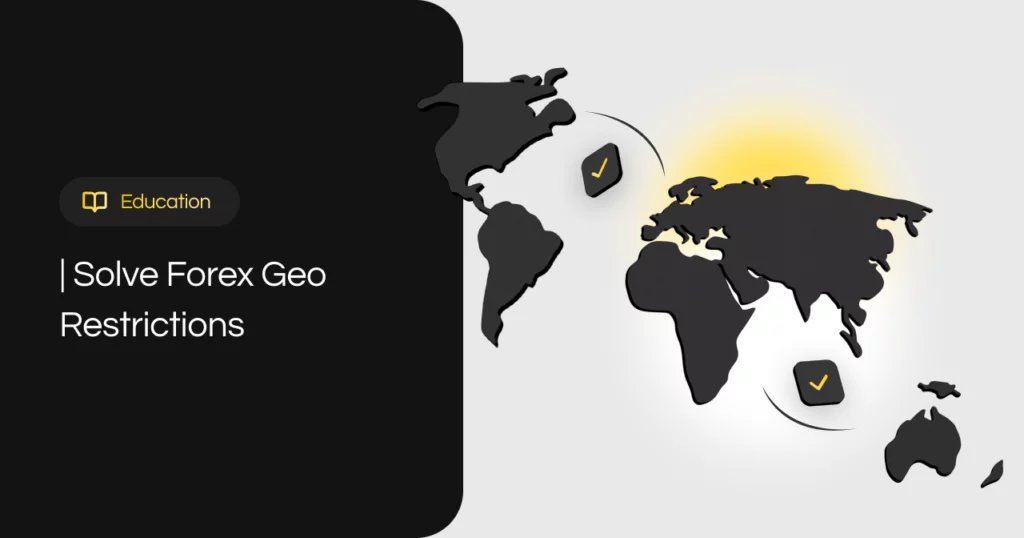
- Geo-restrictions in forex are usually a payment problem rather than a demand problem; the traders exist, but the banking rails do not reach them.
- Card networks and correspondent banking decline or block a large share of deposits from LATAM, MENA, Africa, and parts of Southeast Asia.
- USD-based stablecoins move across borders in minutes, letting brokers accept deposits and send payouts where local banking coverage is thin.
- Match2Pay gives brokers one regulated API to fund accounts and pay clients across regions, without opening a bank relationship in each one.
There is no shortage of people who want to trade forex in Lagos, São Paulo, Karachi, or Manila. What is short is a payment rail that will move their money. Geo-restricted forex payments, declined cards, blocked wires, and correspondent banks that refuse certain corridors all cap how far a broker can grow, long before regulation or real demand ever does. Crypto changes that math, and it is why brokers chasing new markets keep arriving at the same answer.
Geo-Restrictions Are a Banking Problem, Not a Market Problem
The traders are already there. The World Bank’s Global Findex 2025 puts the number of adults without a bank account at roughly 1.3 billion, concentrated in exactly the regions where retail trading interest is climbing fastest. When a broker cannot accept a deposit from a willing client, the limit is the payment rail, not the size of the market.
Traditional rails make that limit worse. Card issuers decline cross-border and high-risk transactions, correspondent banks drop unprofitable corridors, and currency controls trap funds inside national borders. A trader in a restricted corridor is not unwilling to fund an account; the rail in front of them refuses to carry the money.
How Stablecoins Move Money Where Banks Will Not
A blockchain network does not check which country a wallet sits in. USD-based stablecoins settle from one wallet to another in minutes, at any hour, regardless of whether the sender’s country has reliable banking. That is what lets a broker take a deposit from a region its bank would never clear.
For the trader, the experience is a wallet and a payment address instead of a card form that gets declined. For the broker, incoming value can be held in USD-based stablecoins or converted to fiat for settlement, so reaching a new market does not mean holding volatile assets, all through one crypto payment infrastructure for FX and CFD brokers. USDT-to-USD conversions settle at a fixed 1:1 rate with no currency exposure, while conversions into other fiat currencies, such as EUR, carry a standard market rate.
Reaching LATAM, MENA, Africa, and Southeast Asia
These are the regions where the gap between trading interest and banking access is widest. Mobile-first populations in Latin America, the Middle East and North Africa, sub-Saharan Africa, and Southeast Asia already use digital wallets daily, often more readily than they use a bank account. For these traders, crypto is frequently the most familiar payment method available, more so than a card or a wire.
Match2Pay already supports deposits from clients across these continents and works with every crypto wallet, including one-click payment integrations with more than 500 of them, where the client scans a QR code and confirms the transaction with no address or amount to copy over, so a broker can accept the methods local traders prefer without building a separate stack per region. The result is one onboarding flow through a single regulated payment API that works for a client in Bogotá and a client in Jakarta alike.
Lower Friction Means Lower Cost and Fewer Disputes
Expanding through crypto rails also removes costs that quietly erode cross-border margins. There are no card scheme fees on crypto flows, no fixed monthly minimums, and on payouts, Match2Pay charges zero processing cost, so serving a far-flung market does not get more expensive on every transaction.
Blockchain settlement is final, which matters more in new markets than established ones. Because crypto payments cannot be charged back, brokers entering high-risk corridors avoid the friendly fraud and dispute pressure that often make those regions unprofitable on cards. That finality is part of why crypto opens markets that traditional processors treat as too risky to touch.
Map the Markets Your Bank Keeps Closing
Working out which regions your current rails are blocking? Book a session with the Match2Pay team to see which corridors crypto opens for your brokerage and how quickly the integration goes live.
Frequently Asked Questions
Is accepting crypto deposits legal in restricted regions?
Crypto rails move value across borders, but a broker remains responsible for its own licensing and the rules of each market it serves. Match2Pay includes AML screening and risk monitoring to support compliance, though that does not replace a broker’s own regulatory obligations.
Do I have to hold cryptocurrency to accept crypto deposits?
No. Incoming crypto can be held as is or converted to fiat for settlement, so a broker decides how much crypto exposure to take on, if any.
Which regions benefit most from crypto forex payments?
The biggest gains come from markets where banking coverage is thin, but trading interest is high, including parts of Latin America, the Middle East and North Africa, sub-Saharan Africa, and Southeast Asia. In these corridors, crypto often succeeds where cards and wires are declined outright.